
Streptopelia risoria | Ring-necked dove, ringed turtle-dove, or Barbary dove
Names:
- Male: Podrick, Samanya, Shireen, Stannis, Tywin
- Female: Olly, Walda
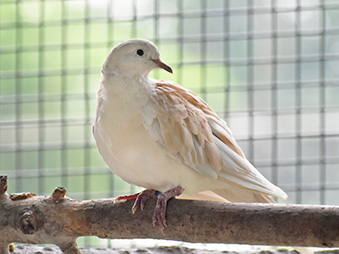
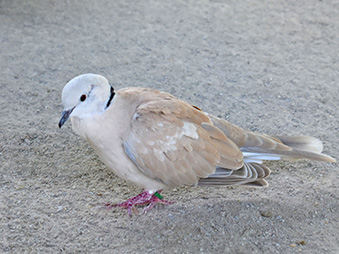
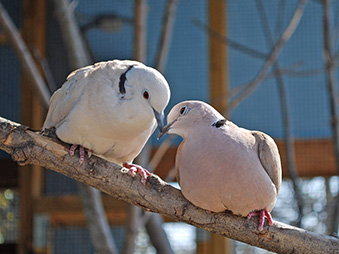
Meet the Ring-Necked Doves
Soft coos, graceful wings, and a signature black crescent at the nape of their necks—meet our enchanting flock of ring-necked doves. This elegant marking gives the species its name and makes them instantly recognizable. Admired by humans for centuries, these gentle birds are known for their calm temperament, soothing voices, and long history as human companions.
Though they may seem like creatures of the wild, ring-necked doves have a fascinating past. They are a domesticated species, descended from the African collared dove, and have lived alongside people for more than 2,000 years. Over time, some were released—intentionally or accidentally—into new environments, where they formed wild populations in places far from their original range.
A Bird of Many Landscapes
Ring-necked doves are remarkably adaptable. In the wild, they can be found in semi-desert scrublands, Acacia savannahs, woodlands, farmlands, and agricultural fields. This flexibility allowed them to establish large populations in areas such as North Africa, the Caribbean islands, and parts of the United States, including southern Florida, Los Angeles, and even as far north as Illinois.
Wild doves spend much of their time foraging on the ground, dining on grass seeds, cereal grains, fruits, berries, and the occasional protein-rich insect like termites and weevils.
Here at the zoo, their menu is carefully balanced with small-bird maintenance chow, seeds, fresh produce, and hard-boiled egg to support their health and longevity.
Social Bonds and Soothing Songs
Ring-necked doves may appear quiet and reserved, but they are deeply social birds. They often live alone or in pairs yet will gather in large flocks when food or water is abundant.
These doves are monogamous, frequently forming lifelong pair bonds. Mated pairs return to the same nest multiple times a year, making small renovations each season. The male gathers and delivers nesting materials—twigs, grasses, and roots—while both partners share incubation duties.
Their parental instincts are especially impressive: ring-necked doves will incubate eggs that aren’t their own and are known to successfully raise chicks from other dove species. In fact, they have been used to help raise mourning dove chicks.
Vocal communication plays an important role in their relationships. Females tend to produce soft, trilling calls, while males are often louder and may perform a bowing display to court or reinforce bonds with their partner.
A History of Partnership with People
After more than two millennia of domestication, ring-necked doves are notably comfortable around humans—though they still retain wild survival instincts. A sudden shadow overhead may cause them to freeze instantly; a reflex shaped by the threat of aerial predators like hawks.
One of their most extraordinary adaptations lies hidden within their heads. Special magnetic tissues allow ring-necked doves to sense Earth’s magnetic field, helping them determine direction and navigate long distances. This remarkable ability made doves and pigeons invaluable as messenger birds, particularly during times of war.
Fact Sheet
Taxonomy
Genus: Streptopelia | Species: risoria |
Kingdom: Animalia | Phylum: Chordata | Class: Aves | Order: Columbiformes | Family: Columbidae |
Favorite Enrichment Type
Items to make nests with such as feathers, sticks, bamboo, straw, and newspaper strips. They also love when they are offered spray millet as a treat!
Life Span
- In the Wild: average believed to be 1.5 years
- In Human Care: 10 to 15+ years
Diet
- In the Wild: Grass seeds, cereal grains, fruits, berries, and occasionally insects like termites and weevils.
- At the Zoo: Specialized psittacine mix.
Geographic Range
North Africa, Caribbean islands, California, Florida, and Illinois.
Habitat
Scrub and grasslands.
Fun Facts
- Signature Identifying Feature: The black crescent on their neck.
- Ring-necked doves have been domesticated for over 2,000 years.
- They can sense Earth’s magnetic field thanks to special tissues in their heads.
- These doves will raise chicks that aren’t their own, even those of different dove species!
- Males court females with bowing displays and louder coos.
- In the wild, they live about 1.5 years, but in human care they can live over a decade.
- Despite their calm nature, they still freeze when a shadow passes overhead, a built-in predator defense.
Status: Not Evaluated
A Conservation Note
While ring-necked doves have successfully established wild populations, the release of domesticated animals into natural environments can be deeply harmful. Introduced species may compete with native wildlife for food and nesting sites, spread disease, or disrupt fragile ecosystems. Even well-intentioned releases can have long-lasting environmental consequences, reminding us why responsible animal care and habitat protection are so important.
How to Find Us
Head on over to the Aviary, located between the Outback Habitat and the Capuchin Habitat. While you’re there, check out the other super cool birds that call the Aviary their home.